Contract Assignment in Romanian Real Estate: What It Is, How It Works and What to Check Before You Sign
5 May 2026 • Real estate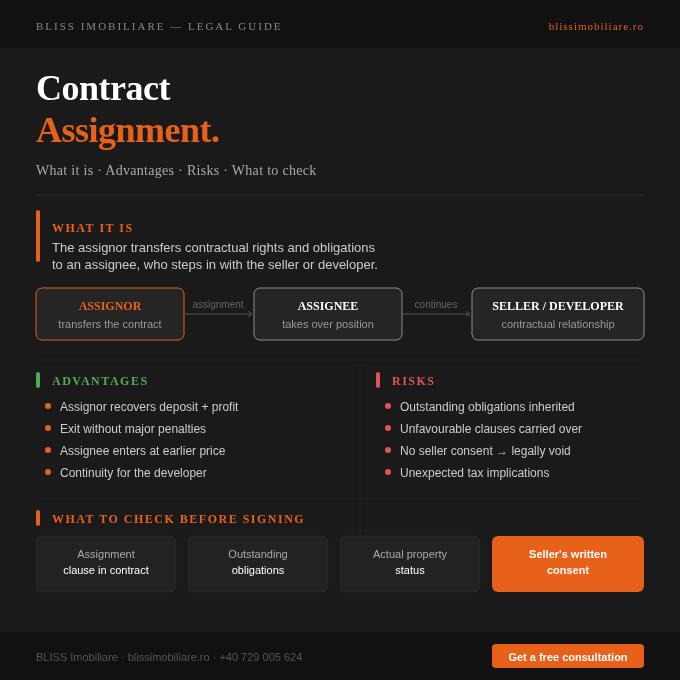
This article is for informational purposes only and does not constitute legal, tax, or financial advice. For specific situations, consult a qualified professional.
Romanian real estate comes with its share of legal terminology that buyers and sellers encounter — often for the first time — at the moment of signing. One term that appears regularly, particularly in new residential projects and off-plan transactions, is cesiune, or contract assignment.
This article explains what a contract assignment is, how it works in practice, what advantages it offers, what risks it carries, and what must be checked before agreeing to one — whether you are the party transferring the contract or the party taking it over.
What is a contract assignment in real estate?
A contract assignment is the legal operation by which one party — the assignor — transfers their rights and obligations under an existing contract to a third party — the assignee — who steps into the assignor's position in the contractual relationship.
In real estate, the most common scenario involves the assignment of a pre-sale agreement (promisiune de vânzare-cumpărare) or an instalment purchase contract. The original buyer transfers their contractual position to a new buyer, who takes over both the right to acquire the property and the payment obligations already assumed.
In simple terms: the assignee steps into the shoes of the assignor and continues the contractual relationship with the seller or developer from the point where the assignor left off. This operation is governed by the Romanian Civil Code and must comply with the conditions set out by law — including, in most cases, the written consent of the other contractual party.
Where does contract assignment appear in practice?
The most common situations in which assignment arises in Romanian real estate are:
- New residential projects (off-plan): A buyer has signed a pre-sale agreement with a developer and paid a deposit, but later decides they no longer want or are no longer able to complete the purchase. Rather than rescinding the contract and losing the deposit, they assign their contractual position to a new buyer.
- Investors exiting before completion: Investors who purchase units at the project stage to benefit from lower prices may use assignment to realise a profit before the final handover, without going through a standard resale transaction.
- Unforeseen personal circumstances: Divorce, relocation abroad, financial changes — situations in which the original buyer can no longer proceed, but the contract is already in place.
- Reorganisation between legal entities: Transferring a contractual right from one company to another within a group or following a restructuring.
The advantages of contract assignment
For the assignor (the party transferring the contract)
- Recovery of the deposit and potential profit: If the property value has risen since the pre-sale agreement was signed, the assignor can transfer the contract at a higher price than originally paid, generating a gain without completing the purchase.
- Exit without major penalties: Rescinding a pre-sale agreement often involves losing the deposit or paying damages. Assignment can provide a less costly way out.
- Flexibility: The assignor can exit a contractual commitment without waiting for project completion or going through a standard property sale.
For the assignee (the party taking over the contract)
- Access to a previously negotiated price: If market prices have increased, the assignee may take over a contract at a price below the current market level.
- Entry into a partially completed project: The assignee benefits from progress already made — advanced construction, deposit already paid, documentation already processed.
- Possibility of customisation: In projects that allow modifications before completion, the assignee may retain the right to personalise certain finishes or elements of the property.
For the developer
- Contractual continuity: The project is not disrupted by a buyer's exit. Payments continue, timelines remain intact, and the contractual relationship is maintained.
- Avoiding disputes: A rescission can generate conflict. A properly documented assignment maintains stability in the contractual relationship.
The risks and challenges of contract assignment
Risks for the assignee
- Inheriting unperformed obligations: The assignee takes over the contract with all its obligations — including any outstanding ones. If the assignor has accumulated penalties or arrears, the assignee must be fully aware of these before signing.
- Insufficient review of the original contract: If the pre-sale agreement contains unfavourable clauses — unrealistic deadlines, disproportionate penalties, absent guarantees — the assignee inherits them in full.
- Absence of the seller's or developer's consent: Many contracts prohibit assignment without the written consent of the other party. An assignment carried out without this consent may be legally void.
- Project-related risks: The assignee must verify the actual construction stage, existing permits, and realistic completion timelines — not solely on the basis of what the assignor states.
Risks for the assignor
- Residual liability: In certain contractual structures, the assignor may remain jointly liable to the seller if the assignee fails to meet their obligations. This must be addressed explicitly in the assignment document.
- Tax implications: Any gain realised through the assignment of a contract may be subject to income tax. A tax consultation is advisable before finalising the transaction.
What must be verified before proceeding with an assignment
- The original contract: Does it contain a clause permitting or prohibiting assignment? Is the written consent of the seller or developer required?
- Status of obligations: Does the assignor have outstanding payments, penalties, or unmet obligations toward the seller?
- Property status: Valid permits, actual construction progress, realistic completion timelines.
- Structure of the assignment document: The assignment must be drafted by a lawyer and, depending on the nature of the contract, may require notarial authentication.
- Tax implications: Both the assignor and the assignee should understand the tax treatment of the operation before signing.
- Written consent of the seller or developer: Without it, the assignment may be null and void under Romanian law.
Conclusion
Contract assignment is a legitimate and useful legal tool in real estate transactions — but it works correctly only when it is professionally documented and executed with full understanding of the obligations involved for all parties.
It is not a shortcut. It is a legal operation with real consequences for the assignor, the assignee, and the seller or developer. Clarity and thorough document review are the only real guarantees of a successful assignment.
If you are in a situation where assignment is an option — whether you are looking to transfer a contract or to take one over — the BLISS Imobiliare team can provide clarity, practical guidance, and document review at every stage.
Contact us: +40 729 005 624 | blissimobiliare.ro